Showing posts with label Disneyland. Show all posts

Tuesday, May 2, 2023

Davy Crockett and the River Pirates

Davy Crockett and the Improved in Every Way


What's it about?

Tonight's nostalgic pic is "Davy Crockett and the River Pirates" (Disney, 1956). We join frontiersman Davy Crockett (Fess Parker) and his brother-in-arms George Russel (Buddy Ebsen) during a trapping expedition in Kentucky in the spring of 1810. Loaded with as many animal skins as they carry, they plan to hire a river boat to take them to New Orleans to get top dollar for their wares.

"Try not to screw this up too, will ya, Georgie?" "Okay, Davy."

When they reach the port of Maysville on the Ohio River, they meet the boisterous and rude giant of a man Mike Fink (Jeff York), captain of the Gullywhumper out of Pittsburgh, who declares himself loudly (and often) that he's "king of the river."
The Gullywhumper cometh.

"A $1000? We could almost buy our own ship for that!" "But who's going to pilot it? You?"

When Fink offers Davy and George passage to New Orleans for $1000 (an astronomical sum at the time), the duo opt instead to enlist the aid of the elderly Captain Cobb (Clim Blevans) of the Bertha Mae who is in need of the crew.
Captain "Cornonna" Cobb.

It turns out that "Injuns" downriver have been attacking river boats ruthlessly, and very few are willing to risk their lives. While the two try to round up able bodies for Cobb, George accidentally attempts to enlist one of Fink's boatmen. This leads to an impromptu drinking contest where the lightweight George bets the furs that he and Davy will make it to New Orleans before Fink and his crew.
Also, he rides a wagon wheel chandelier, which I found quite funny.

The two boats begin a head-to-head race where the wily Mike Fink uses every dirty trick in the book, but can he beat Davy Crockett with his determination, level-headedness, and kindness?
What a strange race.

Can the two crews defeat the notorious pirates that are plaguing the river?
Prob'ly.

Disney: Not leaving money on the table since 1955.

This semi-prequel takes place in between the events of the first film, "Davy Crockett: King of the Wild Frontier" (Disney, 1955), which was necessary, because Disney rather shortsightedly ended that film with Davy Crockett's death at the Alamo as the show's popularity blew up. Similar to the previous film, this is a composite of footage from the last two episodes of the Davy Crockett television show (specifically, "The Wonderful World of Disney Presents Davy Crockett's Keelboat Race" and "Davy Crockett and the River Pirates"). Perhaps because it limits the scope of the story it is telling, it seems a bit more cohesive and less rambling than the other movie.

Also, the action scenes are far less "bad fight choreography" and more "man v. the elements."

The first half of the film focuses on the race between the Gullywhumper and the Bertha Mae, and after that is resolved the second half focuses on Davy and Mike Fink combining resources to stop the pirates who are masquerading as Native Americans to prevent a war between the colonists and the indigenous people.
Cultural appropriation at its worst.

Better than the last one.

Between the two films, I prefer this one. It's storytelling focus, while a bit more formulaic, nonetheless allows for more character development. Mike Fink gets a pretty good redemption arc, going from cheating villain to endearing friend by the end of the movie.
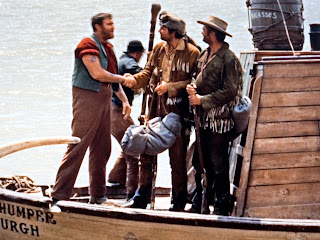
"All is forgiven, Davy." "Uhhhhhhhhh... Okay, Mike."

Buddy Ebsen's George Russel is a more effective comedic foil than in the first film, and even Fess Parker is considerably more relaxed as Davy isn't required to be quite as wooden and stoic in this iteration. The river pirates themselves are so unabashedly evil that it is really satisfying seeing the films heroes take them down for their misdeeds.
"And after we kill Fink's crew, we'll skin puppies to make coats!"

There is a surprising amount of singing for a "western" adventure film, including songs sung by Jeff York (as Mike Fink) and a few by Buddy Ebsen. They serve to show the viewer that this is a far more lighthearted tale than the first film, and so I welcome them.

Typical then, problematic now.

Be warned though, there are a lot of film and television staples from the time that are disgustingly present in this production. The most glaring is the representation of Native Americans; although they are not portrayed as the villains, they are still portrayed as stereotypes played by lily white actors pretending to be tribesmen.

"Why are you guys painted red?"

Sharp-eyed viewers will notice that one or two characters in particular are quite literally painted red. There are no other minorities represented or acknowledged, and I'm struggling to remember if there are even any women in the film at all (there certainly aren't any female main characters). If you're looking for diversity in film, this isn't it.
"An' iff'n yew's a Republican, it is!"

This film also continues Walt Disney Studio's use of stock footage to depict natural threats, and it's always tiresome to see.
"Watch out Davy! There's a gator over there in that other lighting scheme and film grain!" 

Watch with kids with caution.

If you're watching with kids, there are a few things you should know: While there's no foul language in the film, the first half depicts Mike Fink as an unrepentant bully who solves many of his problems with threats, intimidation, and his fists. While the second half shows him as a fast friend and stalwart companion won over by Davy's good sportsmanship and kindness, it could trigger children suffering from this sort of abusive trauma in their lives.

Real life bullies are far less likeable than Mike Fink.

There is some (bloodless) gunplay in the film, and lots of implied murder, and on-screen deaths (again, bloodless) of the very bad characters, so if you're trying to limit this sort of media just be aware.
There is a lot of implied murder, actually.

A bit of after-film trivia

Apparently, all of the prop boats used in the film were later used at Disneyland to ferry park visitors through parts of the park, and remained in operation until 1997, when the Gullywhumper capsized injuring several patrons. After closing, the Bertha Mae was sold to a private collector and the Gullywhumper was moored as a background prop before it eventually sunk from a combination of bad weather and disrepair and was removed.

Where can you watch it?

"Davy Crockett and the River Pirates" is currently streaming on Disney+.

Tuesday, September 6, 2022

Mars and Beyond... Maybe.

Beyond space and time, there is... Mars and Beyond!


Tonight's nostalgic pic is "Mars and Beyond" (Disney, 1957). Similarly themed to 1955's "Man in Space," this is another episode of "Disneyland" (AKA "The Magical World of Disney" from when it was originally being broadcast on the ABC network) that deals with space travel.

"Hello Mr. Disney, my name is GARKO, AKA TERROR!"

It starts weird, and stays weird.

It starts with an awkward introduction with Walt Disney (and a rather disturbingly lame robot) before we get to the first animated segment, narrated by the immortal Paul Frees, which deals with man's conception of the Earth's place in the solar system, the galaxy, and the universe. 

You know: This kind of stuff.

This is followed by a fairly detailed look at the evolution of life on planet Earth (which I'm sure caused quite a stir with religious ignorance in 1957… and sadly probably now, 65 years later). 

Carbon bonding to form the proteins that would form life, circa 1957.

"If exposed to even a few degrees beyond these limits, man would expire." But you know: Climate change is no big deal. *sigh*

From here we transition to a historical (and quite comedic) overview of mankind's infatuation with the idea of life on other planets within the solar system. 

This segment isn't even pretending to be scientifically accurate.

Dig those crazy cartoons.

Pictured: Tripod-like war machines from "The War of the Worlds."

Martian and Martian horse. What where they smoking?


This leads into a very 1950s overview of what the surface and life on Mars might be like, hosted by E.C. Slipher, one of the premiere Mars astronomers of his day. 

Slipher, no sliphing!


I'm still curious as to what this "cloud" formation was. Maybe a warning about the election in 2000?

Ah, the "canals" of mars in all their glory.

If you're offended by me calling a Nazi a Nazi, you might actually be a Nazi.

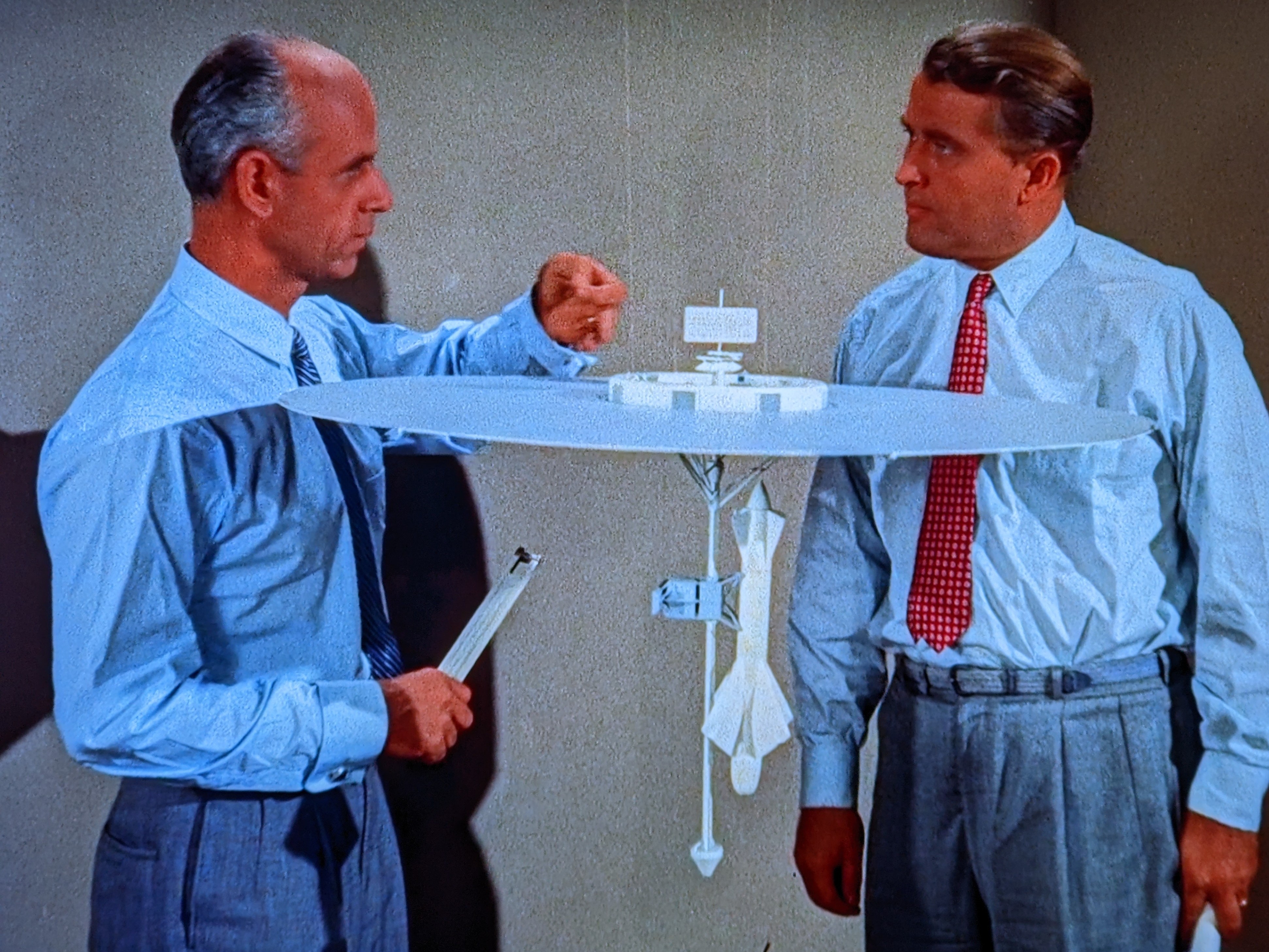
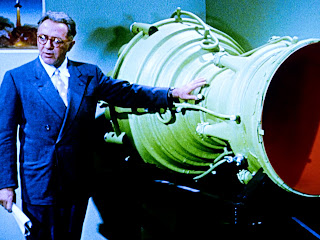
The final segment is an imagination of the first mission to Mars through the (incredibly optimistic) lens of 1950s space technology. This segment relies on designs proposed by World War II veteran (guess which side) Ernst Stuhlinger and fellow "Operation Paper Clip" beneficiary (and bonus Nazi) Wernher von Braun.

Pictured on the left: Regular German. Pictured on the right: Actual Nazi.


Side note: Operation Paper Clip was a U.S. program that allowed German scientists (even Nazis, SS officers, and other actual war criminals) to come to the States to continue their work on rocket propulsion, basically without any acknowledgement or punishment for their crimes against humanity. Your tax dollars at work.

Nazi scum aside, I really did enjoy this episode. I love these 1950s style cartoons with their bold cubism-inspired designs and simple animation, but you'd be forgiven for not knowing that this was a Disney animated production because of that (other than one absolutely hilarious and brief cameo by Donald Duck). Most of the episode deals more with mythology, science fiction, and outright fantasy than science fact, which does somewhat unfavorably shade the historicity of the program, but I do have to say that the scientific speculation parts are a fascinating time capsule of what the public at large thought the surface of other planets were like before unmanned space probes and extra-atmospheric telescopes existed. 

1957 artist's concept of the surface of Pluto.

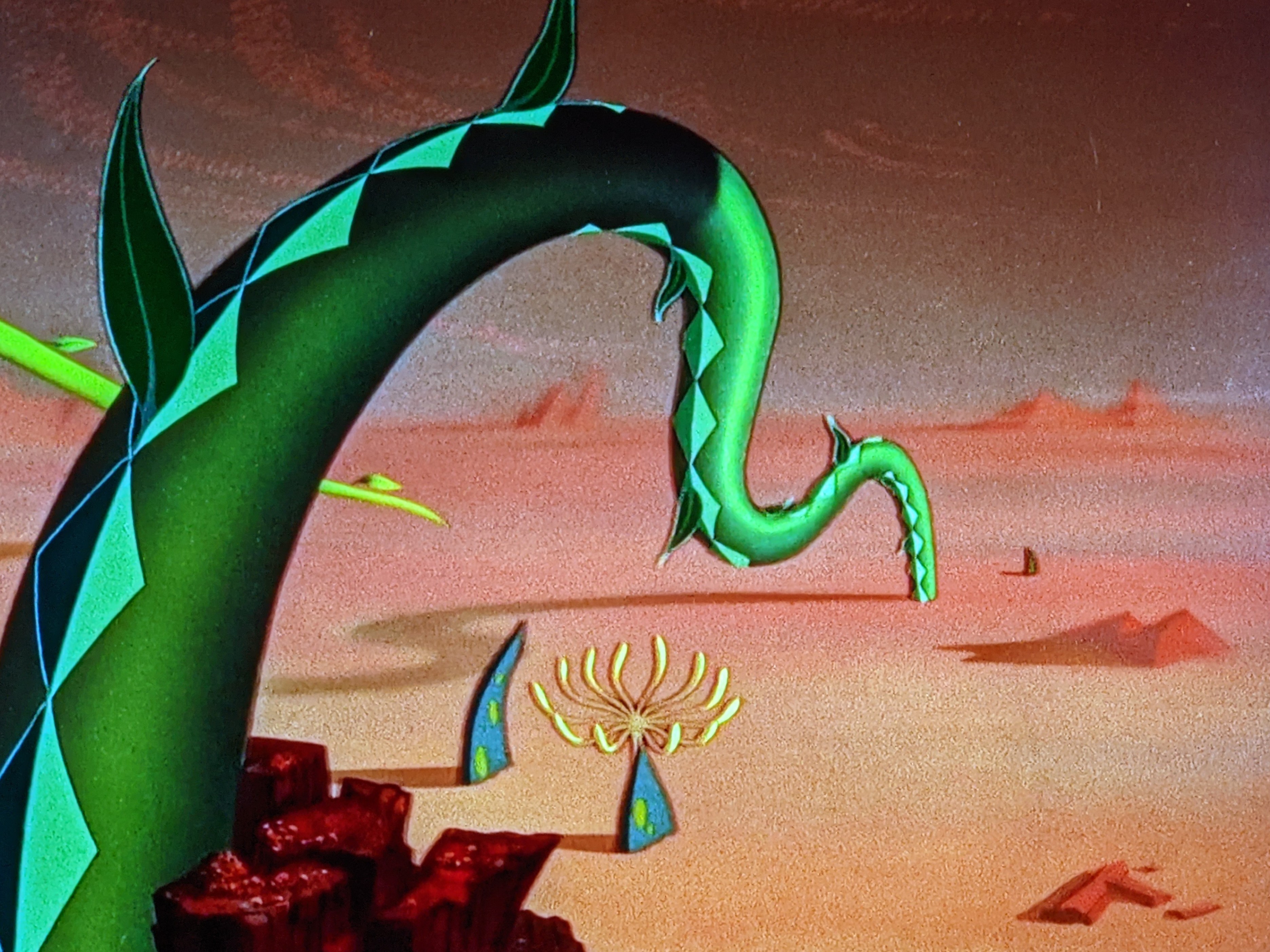
1957 artists concept of Mars.

The speculation is funny to witness now, and I think that Disney's "Imagineering" department took a lot of liberties with exobiology, but it is entertaining to watch even if the actual educational value is compromised. 

Let's just say that hope for life on Mars was very "optimistic."

Pictured: Martian Black Mage.

"Okay everyone, just hold your breath for 18 months."

The Mars mission segment is delightfully misleading, not even addressing small things like how 20 men would be able to eat and breathe on a small spaceship for an over three-year mission to Mars and back, and making the hilarious assumption that we would send men to the surface of Mars before ever materially touching the red planet with satellites or unmanned probes.

Ah, yes: America's famous 1950s space station.

You know why I never became an astronaut? NO LABELS ON THE BUTTONS.

The fleet departing for the first mission to Mars. Ever.

Preparing the Mars landing module.

Recommended.

I loved it, and recommend it for entertainment purposes. "Mars and Beyond" is currently streaming on Disney+.

Excelsior!


Tuesday, August 23, 2022

Man In Space

 "Hey kids! Do you want to see a color program about the history of space travel?"

"Yeah!"

"Do you want to see some humorous animations of what our American astronauts can expect from life in zero gravity!"

"Yeah!"

"Do you want to see a serious look at an actual space mission might entail?"

"Yeah!"

"Do you want to see known members of the Nazi party, well-fed and walking around freely thanks to Operation Paperclip?"

"Yea -- wait, what was that last one?"

Walt Disney at his desk
"Damn minorities."


Yes kids, tonight's nostalgic pick is "Man In Space" (Disney, 1955), a television program about space travel from a time before that existed. This was part of the Disney series of television specials back when the show was known as "Disneyland." Unlike a lot of the other Disneyland programs streaming on Disney+, someone had the foresight to upload the color version (even though it wouldn't have been seen in color during the original broadcast). It is divided into three segments: 


The first part of the program is a look at the development of rocket technology from ancient China (with a very brief and very racist segment) and gunpowder propulsion to the development of the modern liquid-fuel rocket technology. This bit is bookended by a discussion of rocket physics with Willy Ley, a German scientist who was not a member of the Nazi party.

Landing on the moon
"Ouch!"

Racist caricature of a Chinese man, circa 1955
Can you hear the music playing here?

The trajectory of a V2 rocket
Pictured: Actual science.

German (probably not a Nazi) scientist Willy Ley
German, but not a Nazi.

The second portion is a discussion of space medicine and the effects of outer space might have on a pioneer astronaut. I have to admit, this segment made me laugh (it has a lot of "Goofy" energy). This is mostly done with a cartoon narrated by known enthusiastic member of the German Nazi party and all-around human scumbag Heinz Haber (seriously, read up on the guy). 

Cartoon of a weightless man in space
Narrated by a Nazi. Seriously.

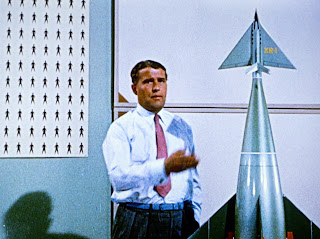
The third and final segment is a lavishly painted (but barely animated) cartoon about what the first mission to space might look like. Its… Ambitious to say the least. It does remarkably resemble a space shuttle mission from the 1980s-2000s, and is eerily accurate for predating those expeditions, but in retrospect it seems a bit like putting the cart before the horse (the mission doesn't really resemble the spacewalks before the space shuttle missions, yet the program predicts that they will preempt a moon mission). This last portion of the program is hosted by (supposedly reluctant) member of the Nazi party Werner von Braun (still an actual member of the Nazi party, though).

Werner von Braun, actual Nazi.
Pictured: Actual Nazi, Werner von Braun.

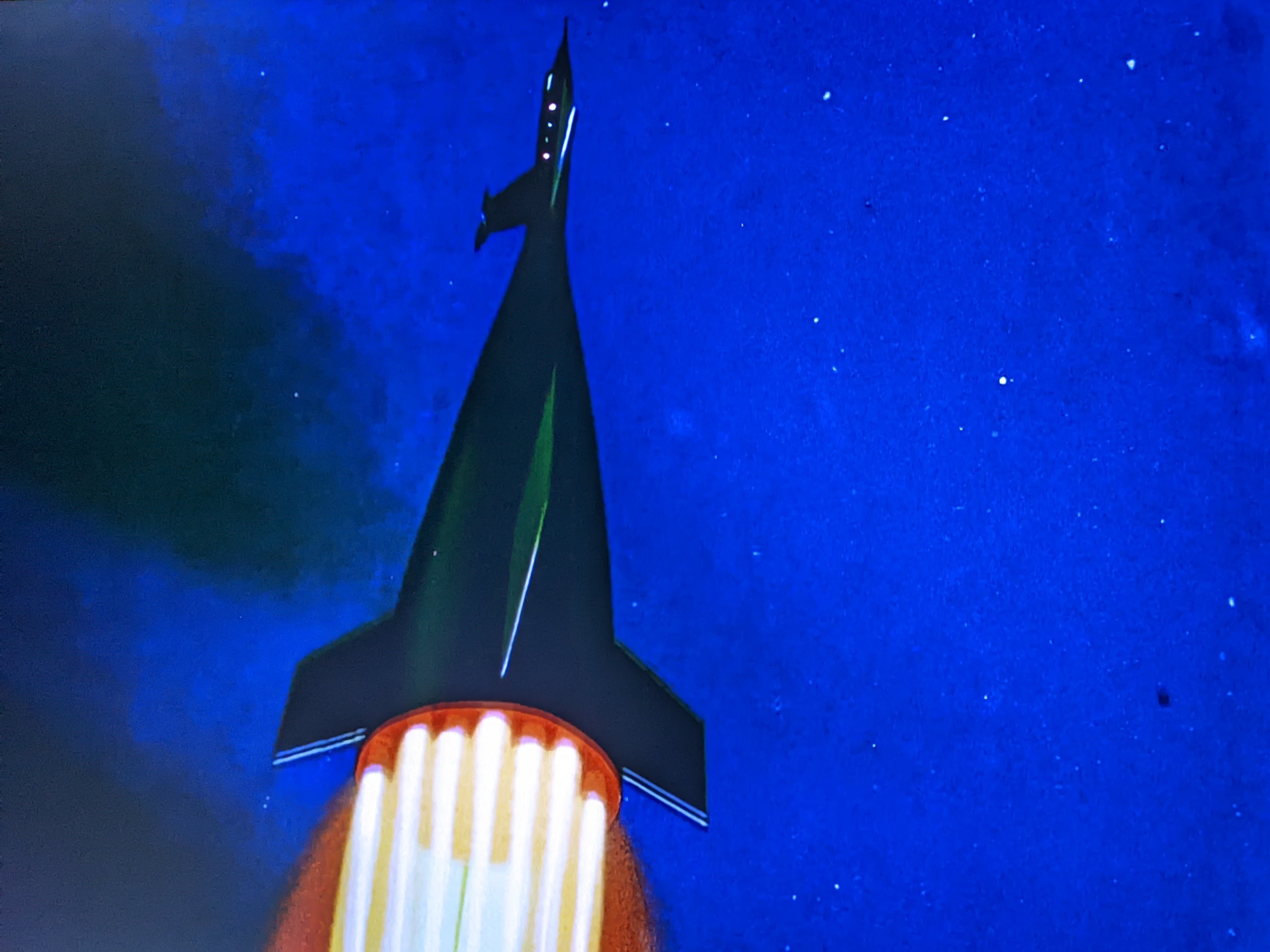
Spaceship rockets into orbit.
Short on animation, beautiful art, though.

Spacecraft in orbit.
Pictured: Not the space shuttle.

So, I'm torn on this one: On the one hand, this is a well-constructed, very informative, and absolutely prophetic vision of what mankind's first steps into space might (and in fact, did) look like. On the other hand, the cost of achieving this knowledge meant our government had to placate and cater to men associated with one of the most unapologetically evil regimes in recorded history (I suppose that's nothing new -- or past -- either). Of course, this is not at all brought up in the program, nor is there an explanatory placard at the start of the program explaining the "it was a different time" B.S. Was it the right call? I don't know, but it's enough to make me question whether or not I can recommend what should have been a slam-dunk "must-see."


"Man in Space" is currently streaming on Disney+, if you want to wrestle with morality.