Tuesday, September 13, 2022

The Last Dragon, at Last!

I loved this film as a child.

Can you taste the 80s? CAN YOU?!

What's it about?

Tonight's nostalgia pic is "The Last Dragon" (Sony/Tristar, 1985). Leroy Green (Taimak) is your typical Harlem youth… Who has spent his life training with a martial arts master (Thomas Ikeda) to learn inner peace -- and butt-kicking. 

Pure of heart, bereft of style.

When his master informs him that he has nothing left to teach, Leroy begins his journey to locate the next master in his training so that he can unlock the "glow" (a superhuman mystical power). Returning to the neighborhood dressed in Chinese garb from the 1800s for some reason, he is immediately dubbed "Bruce Leroy" by the locals which catches the ire of local ganglord Sho'nuff, the self-proclaimed "Shogun of Harlem" (played by Julius Carry III). 

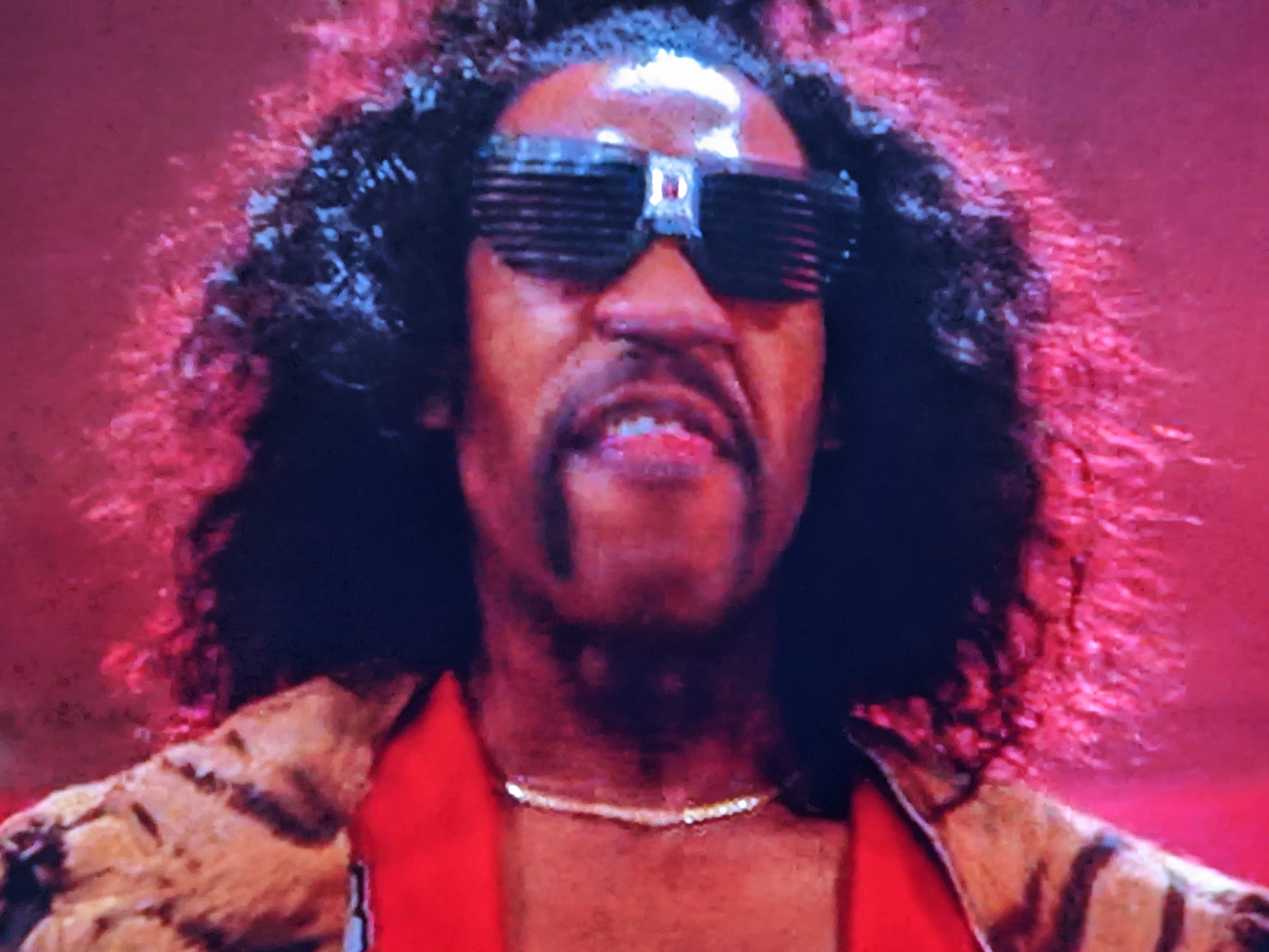
Pictured: Memorable villain.

Meanwhile, video arcade owner and entrepreneur Eddie Arkadian (Christoper Murney) is seeking to get his girlfriend Angela (Faith Prince) onto the hottest television dance program in New York, "7th Heaven," which is hosted by the beautiful Laura Charles (former Prince protégé Vanity). 

I bet you can't tell what decade this is just by this picture.

Eddie's heavy tactics and the goofy nature of Angela's music videos causes Laura to outright reject his business proposition, which leads to Eddie becoming increasingly antagonistic, culminating in him sending goons to assault Laura. 

The real villain is always a rich white man. That's not me being sarcastic: THE REAL VILLAINS ARE RICH WHITE MEN.


I honestly don't know what Laura's problem is: THESE ARE GREAT.

Leroy happens upon this confrontation and saves her, resulting in a romantic bond between the two. As Eddie becomes more unhinged, his thirst for vengeance against Leroy leads to a team up with Sho'nuff to take down the emerging hero. Can Leroy save the people he loves and put an end to the villains' reign of terror?


Definitely maybe.

Nitpicks.

I know that description is a little wordy, but there's a lot (and somehow not much) to unpack with this film. This is an oddly out of time mash-up of 70s "blacksploitation" films and kung-fu movies, with very little detail played to either. You'll notice in the introduction that I mentioned that Leroy studies the "martial arts" and not a specific martial art, because the movie makes absolutely no distinction between them; Leroy is trained by a clearly Japanese man but dresses like a stereotypical Chinese railroad worker (unless he's dressed as a ninja and using Japanese weapons). 

Pictured: Ikeda, an American man of Japanese descent playing a Japanese man training an American man who thinks he is a Chinese man in Chinese Kung-Fu. Got it? Right.

Sho'nuff borrows his aesthetic heavily from Japanese samurai culture, but his moves are mostly kung-fu inspired. It's almost like the American producers loved watching kung-fu movies but couldn't bother doing the minimum of research on the cultures that inspired them.

Still, he is committed.

Cross-platform integration -- now with more synergy!

This is a Motown Productions picture, so there are a lot (and I mean, A LOT) of music videos and music awkwardly shoehorned into the runtime. Most memorable is El DeBarge's "Rhythm of the Night," where DeBarge is totally there… in his video… being played in the background… not interacting with the rest of the cast… 

LIVE! (in video form)

"The Last Dragon" has its own 80s rock theme song, which honestly makes the climax of the film even better. There are also multiple clips of various Bruce Lee movies shamelessly placed throughout the film during the downtime, possibly to distract from the fact that the body of the film doesn't really have much in the way of martial arts action.

DEAD! (but live... in video form)

My opinion: Recommended.

Having said that, let me just say in no uncertain terms that I LOVE THIS MOVIE. Is it a great film? No, but it is the BEST kind of bad movie: It's campy, extremely well-acted (outside of its two romantic leads), and best of all, it's NOT BORING. It's one of the rare instances where I loved the film as a kid and can love it now for completely different reasons. Everyone who saw this as a child (me included) was utterly terrified of Sho'nuff, but as an adult I can appreciate the way Julius Carry absolutely devours the scenery; every single time Sho'nuff and his gang of unrepentant weirdos are onscreen is a delight, a gift from the gods of cheesy goodness. 

Pictured: Entertainment in its purest form.

While most of the film lacks action, and Taimak and Vanity for all their beauty can only give passable performances, the supporting cast is so great (Leroy's family is fantastic, especially Leo O'Brien as his brother, Richie -- the kid gives a fantastic performance, easily one of the best in the film) that it more than evens out. 

Love interest, but not that interesting.


Oddly enough, Vanity's hotness is inversely affected by the size of her hair.

I'm serious: This kid is fantastic and should have had a long career.

There are even a few blink-and-you'll-miss-it cameos by a few familiar faces (Keshia Knight Pulliam from "The Cosby Show" and Chazz Palminteri to name a couple). 

Hm... Can't seem to place him... William H. who?

His character was later murdered by Jim Carrey and Jeff Daniels.

Teenage Mutant Ninja Turtle. Seriously.

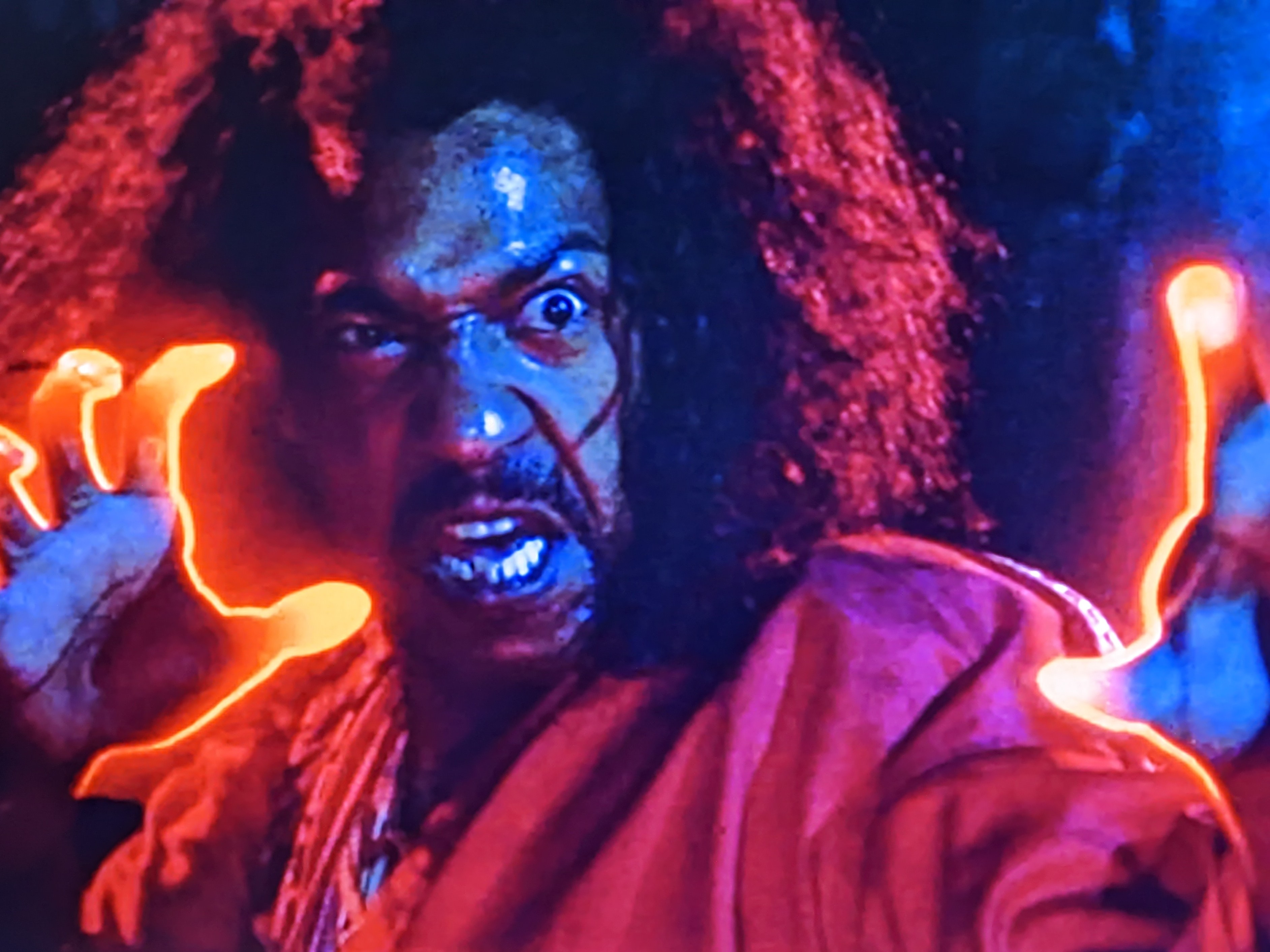
The final fight of the film pits Leroy against various street fighters in a samurai showdown to find out who is the true king of the fighters. Even the animated special effects at the end are a delight, even if they don't really hold up to today's standards.

Insert coins to continue.


Final boss.

Rating and concerns.

While there is no real body count or swearing in this film, it is rated PG-13 for lots of extreme fighting, implied violence, and the occasional use of the "N" word, so just be aware of this if you're watching with young children or just adult idiots who think that it's okay to use.


I know that cultural appropriation is a more sensitive topic nowadays, but these guys were always a little bit offensive.

Where can you find it?

I watched it on DVD, but "The Last Dragon" is currently streaming on HBO Max, and is available for rent or purchase on Amazon Prime Video and VUDU.

Tuesday, September 6, 2022

Mars and Beyond... Maybe.

Beyond space and time, there is... Mars and Beyond!


Tonight's nostalgic pic is "Mars and Beyond" (Disney, 1957). Similarly themed to 1955's "Man in Space," this is another episode of "Disneyland" (AKA "The Magical World of Disney" from when it was originally being broadcast on the ABC network) that deals with space travel.

"Hello Mr. Disney, my name is GARKO, AKA TERROR!"

It starts weird, and stays weird.

It starts with an awkward introduction with Walt Disney (and a rather disturbingly lame robot) before we get to the first animated segment, narrated by the immortal Paul Frees, which deals with man's conception of the Earth's place in the solar system, the galaxy, and the universe. 

You know: This kind of stuff.

This is followed by a fairly detailed look at the evolution of life on planet Earth (which I'm sure caused quite a stir with religious ignorance in 1957… and sadly probably now, 65 years later). 

Carbon bonding to form the proteins that would form life, circa 1957.

"If exposed to even a few degrees beyond these limits, man would expire." But you know: Climate change is no big deal. *sigh*

From here we transition to a historical (and quite comedic) overview of mankind's infatuation with the idea of life on other planets within the solar system. 

This segment isn't even pretending to be scientifically accurate.

Dig those crazy cartoons.

Pictured: Tripod-like war machines from "The War of the Worlds."

Martian and Martian horse. What where they smoking?


This leads into a very 1950s overview of what the surface and life on Mars might be like, hosted by E.C. Slipher, one of the premiere Mars astronomers of his day. 

Slipher, no sliphing!


I'm still curious as to what this "cloud" formation was. Maybe a warning about the election in 2000?

Ah, the "canals" of mars in all their glory.

If you're offended by me calling a Nazi a Nazi, you might actually be a Nazi.

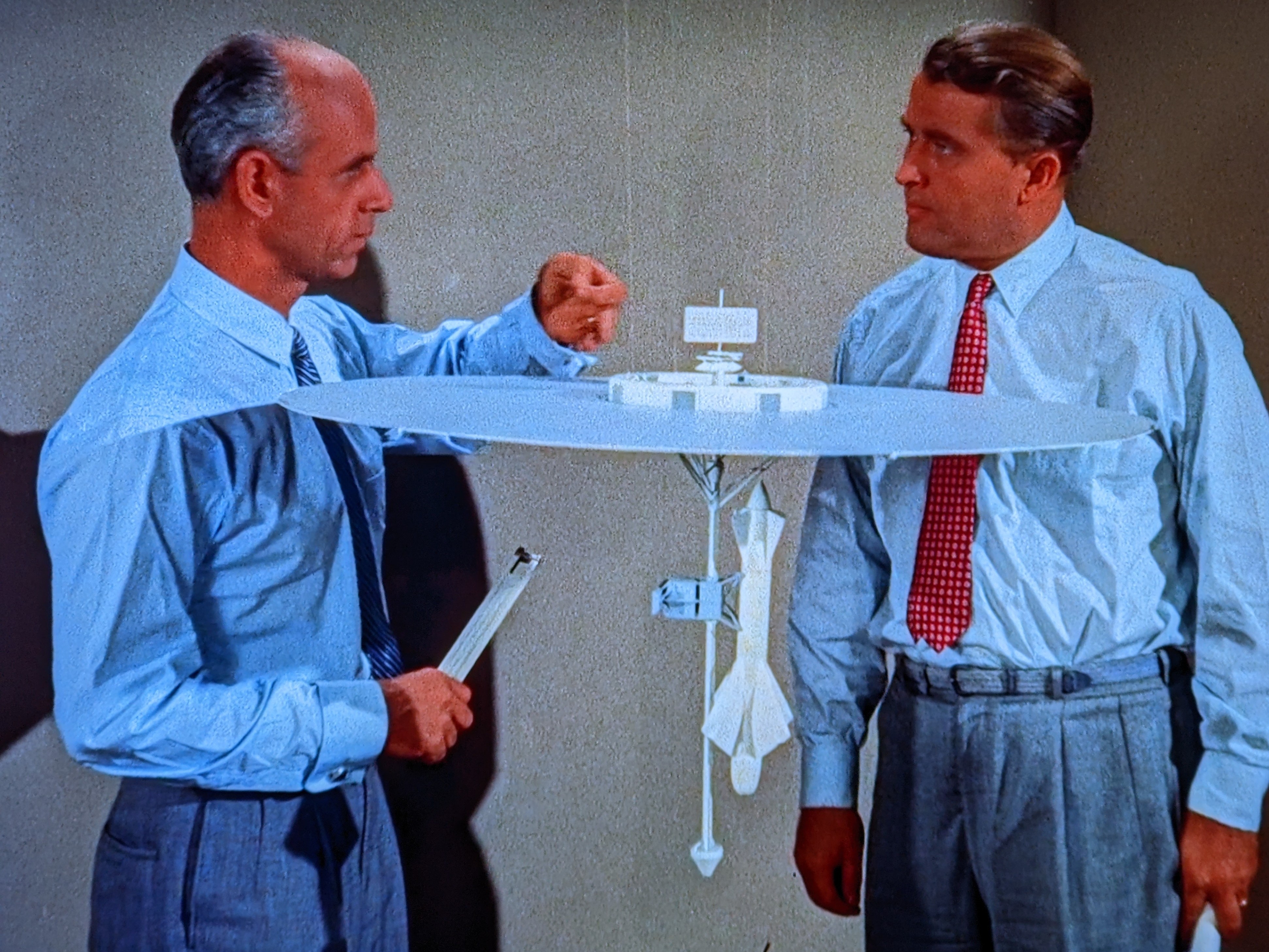
The final segment is an imagination of the first mission to Mars through the (incredibly optimistic) lens of 1950s space technology. This segment relies on designs proposed by World War II veteran (guess which side) Ernst Stuhlinger and fellow "Operation Paper Clip" beneficiary (and bonus Nazi) Wernher von Braun.

Pictured on the left: Regular German. Pictured on the right: Actual Nazi.


Side note: Operation Paper Clip was a U.S. program that allowed German scientists (even Nazis, SS officers, and other actual war criminals) to come to the States to continue their work on rocket propulsion, basically without any acknowledgement or punishment for their crimes against humanity. Your tax dollars at work.

Nazi scum aside, I really did enjoy this episode. I love these 1950s style cartoons with their bold cubism-inspired designs and simple animation, but you'd be forgiven for not knowing that this was a Disney animated production because of that (other than one absolutely hilarious and brief cameo by Donald Duck). Most of the episode deals more with mythology, science fiction, and outright fantasy than science fact, which does somewhat unfavorably shade the historicity of the program, but I do have to say that the scientific speculation parts are a fascinating time capsule of what the public at large thought the surface of other planets were like before unmanned space probes and extra-atmospheric telescopes existed. 

1957 artist's concept of the surface of Pluto.

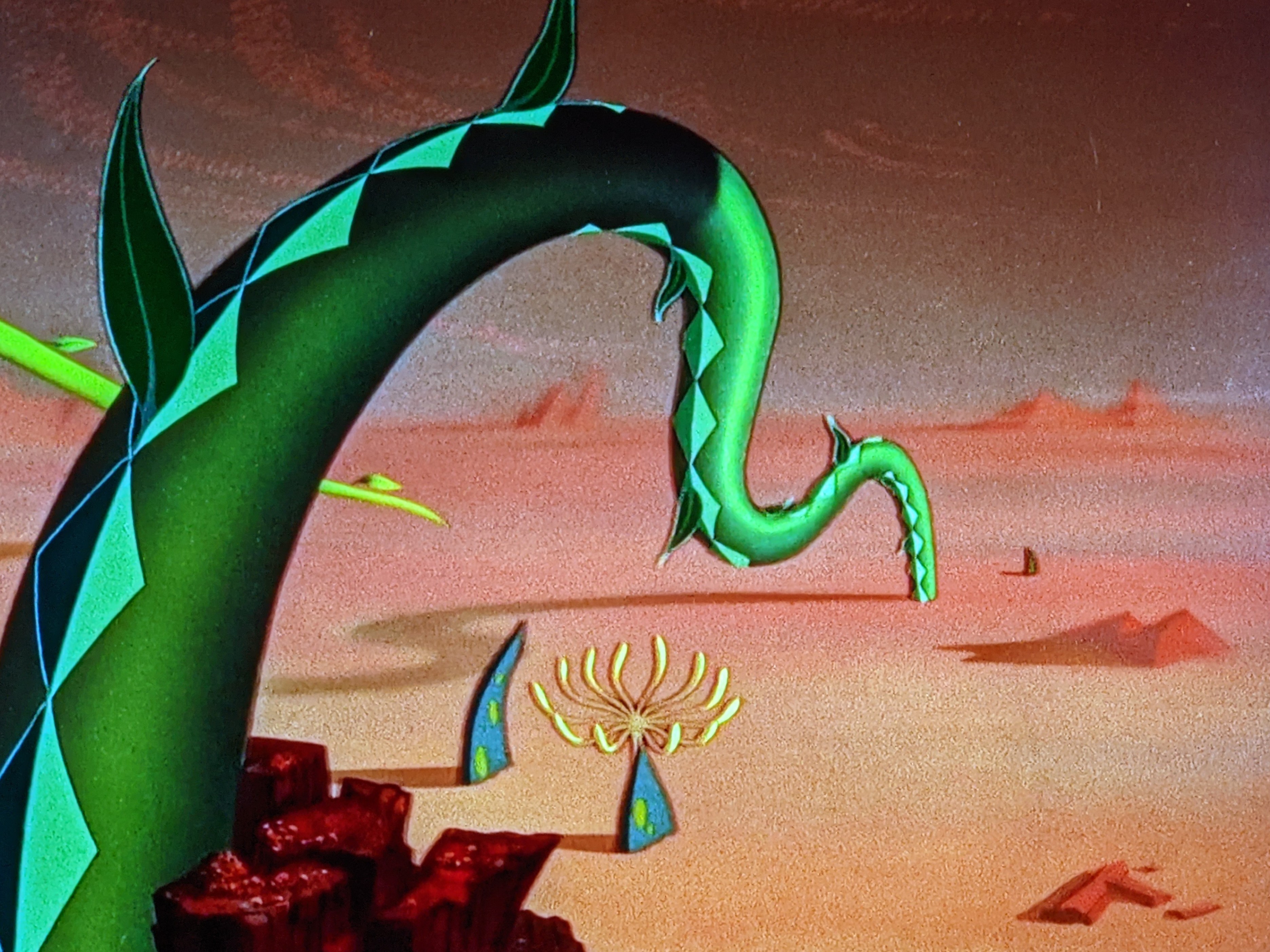
1957 artists concept of Mars.

The speculation is funny to witness now, and I think that Disney's "Imagineering" department took a lot of liberties with exobiology, but it is entertaining to watch even if the actual educational value is compromised. 

Let's just say that hope for life on Mars was very "optimistic."

Pictured: Martian Black Mage.

"Okay everyone, just hold your breath for 18 months."

The Mars mission segment is delightfully misleading, not even addressing small things like how 20 men would be able to eat and breathe on a small spaceship for an over three-year mission to Mars and back, and making the hilarious assumption that we would send men to the surface of Mars before ever materially touching the red planet with satellites or unmanned probes.

Ah, yes: America's famous 1950s space station.

You know why I never became an astronaut? NO LABELS ON THE BUTTONS.

The fleet departing for the first mission to Mars. Ever.

Preparing the Mars landing module.

Recommended.

I loved it, and recommend it for entertainment purposes. "Mars and Beyond" is currently streaming on Disney+.

Excelsior!


Tuesday, August 30, 2022

The Three Musketeers Review

Muskets not Mouse-kets

Four Musky Bois


What is it about?

Tonight's nostalgia pic is "The Three Musketeers" (Disney, 1993). In the early 1600s, France is on the brink of war with England thanks to the manipulation of the ambitious Cardinal Richelieu (played by a disappointingly subdued Tim Curry). An adventurous young man named d'Artagnan (Chris O'Donnell) seeks to follow in his father's footsteps and become one of the king's personal army, known as the "musketeers." d'Artagnan arrives to a Paris in turmoil after the musketeers are disbanded only to be replaced by the Richelieu's personal guard. The ever-confrontational d'Artagnan soon picks fights with three locals, the brooding Athos (Kiefer Sutherland), the boisterous Porthos (Oliver Platt), and the cunning Aramis (Charlie Sheen), only to side with them discovering that they are rogue musketeers fighting for the king's interests. Together the four uncover a conspiracy between Richelieu, his conniving cycloptic general Rochefort (Michael Wincott), and the mysterious Milady DeWinter (Rebecca De Mornay). Can the young man and the three musketeers save France and the King?

Jeez, just ham it up already!


My first impressions

So… Why is this a bad movie? Well, it isn't: It's very adventurous, the production values are high, and while the acting is… Let's just say "questionable…" The cast is among some of the very well-known personalities and rising stars of the time. The action is plentiful, the swashbuckling is exciting, and the whole film just oozes adventure. For the most part, even the death scenes are tasteful and downplayed, making this a mostly family friendly adventure despite is large body count (be aware that there's one scene between Porthos and an ugly dungeon worker that is somewhat bloody and on-screen). The whole adventure ends on a happy note with the bad guys meeting their just rewards and the kingdom restored.

Pictured: Not Robin.


My opinion

Bad movie? No, but do you know what this is? It's a very bad adaptation. I have read "The Three Musketeers" by Alexander Dumas, and after seeing movies like this one my entire life, I was shocked at how different the book of the collected serial stories is. For one thing, character motivations between the book and this film are similar, but not the same. The character of Milady in particular is much more sinister and villainous, even killing d'Artagnan's love interest, Constance, at one point (the character of Constance lives in the film). Her execution in the book is carried out without mercy, while in the film she's a much more sympathetic character. Richelieu's plot is also more layered, involving subterfuge from a tryst between the French queen and England's duke of Buckingham, which is never a plot thread in the movie. Also, in the book Richelieu is mostly left unpunished (because the rich and powerful seldom are). The book ends on a somewhat dark note completely absent from any media adaptation I have ever seen.

This one's for "Backdraft!"


Recommendation

So should you watch it? Yeah sure, why not? It's far from essential viewing, cinematic gold, or even a must-see, but it is an action-packed adventure film with a lot of humor and daring-do, so if you're in the mood for a popcorn flick you could do a lot worse (but also a lot better).

"I'm Platt-man!"


Where can I find it?

"The Three Musketeers" is currently streaming on Disney+.

My Doctor-eight! Get it? Doctor eight? No?


Tuesday, August 23, 2022

Man In Space

 "Hey kids! Do you want to see a color program about the history of space travel?"

"Yeah!"

"Do you want to see some humorous animations of what our American astronauts can expect from life in zero gravity!"

"Yeah!"

"Do you want to see a serious look at an actual space mission might entail?"

"Yeah!"

"Do you want to see known members of the Nazi party, well-fed and walking around freely thanks to Operation Paperclip?"

"Yea -- wait, what was that last one?"

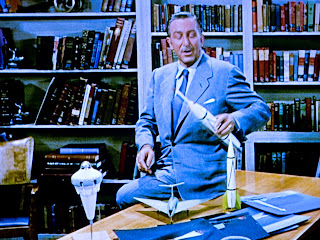
Walt Disney at his desk
"Damn minorities."


Yes kids, tonight's nostalgic pick is "Man In Space" (Disney, 1955), a television program about space travel from a time before that existed. This was part of the Disney series of television specials back when the show was known as "Disneyland." Unlike a lot of the other Disneyland programs streaming on Disney+, someone had the foresight to upload the color version (even though it wouldn't have been seen in color during the original broadcast). It is divided into three segments: 


The first part of the program is a look at the development of rocket technology from ancient China (with a very brief and very racist segment) and gunpowder propulsion to the development of the modern liquid-fuel rocket technology. This bit is bookended by a discussion of rocket physics with Willy Ley, a German scientist who was not a member of the Nazi party.

Landing on the moon
"Ouch!"

Racist caricature of a Chinese man, circa 1955
Can you hear the music playing here?

The trajectory of a V2 rocket
Pictured: Actual science.

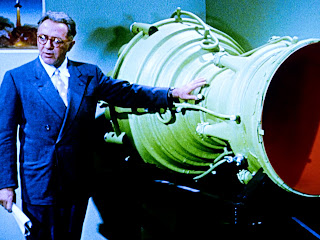
German (probably not a Nazi) scientist Willy Ley
German, but not a Nazi.

The second portion is a discussion of space medicine and the effects of outer space might have on a pioneer astronaut. I have to admit, this segment made me laugh (it has a lot of "Goofy" energy). This is mostly done with a cartoon narrated by known enthusiastic member of the German Nazi party and all-around human scumbag Heinz Haber (seriously, read up on the guy). 

Cartoon of a weightless man in space
Narrated by a Nazi. Seriously.

The third and final segment is a lavishly painted (but barely animated) cartoon about what the first mission to space might look like. Its… Ambitious to say the least. It does remarkably resemble a space shuttle mission from the 1980s-2000s, and is eerily accurate for predating those expeditions, but in retrospect it seems a bit like putting the cart before the horse (the mission doesn't really resemble the spacewalks before the space shuttle missions, yet the program predicts that they will preempt a moon mission). This last portion of the program is hosted by (supposedly reluctant) member of the Nazi party Werner von Braun (still an actual member of the Nazi party, though).

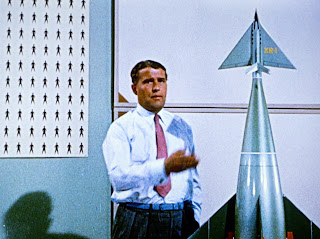
Werner von Braun, actual Nazi.
Pictured: Actual Nazi, Werner von Braun.

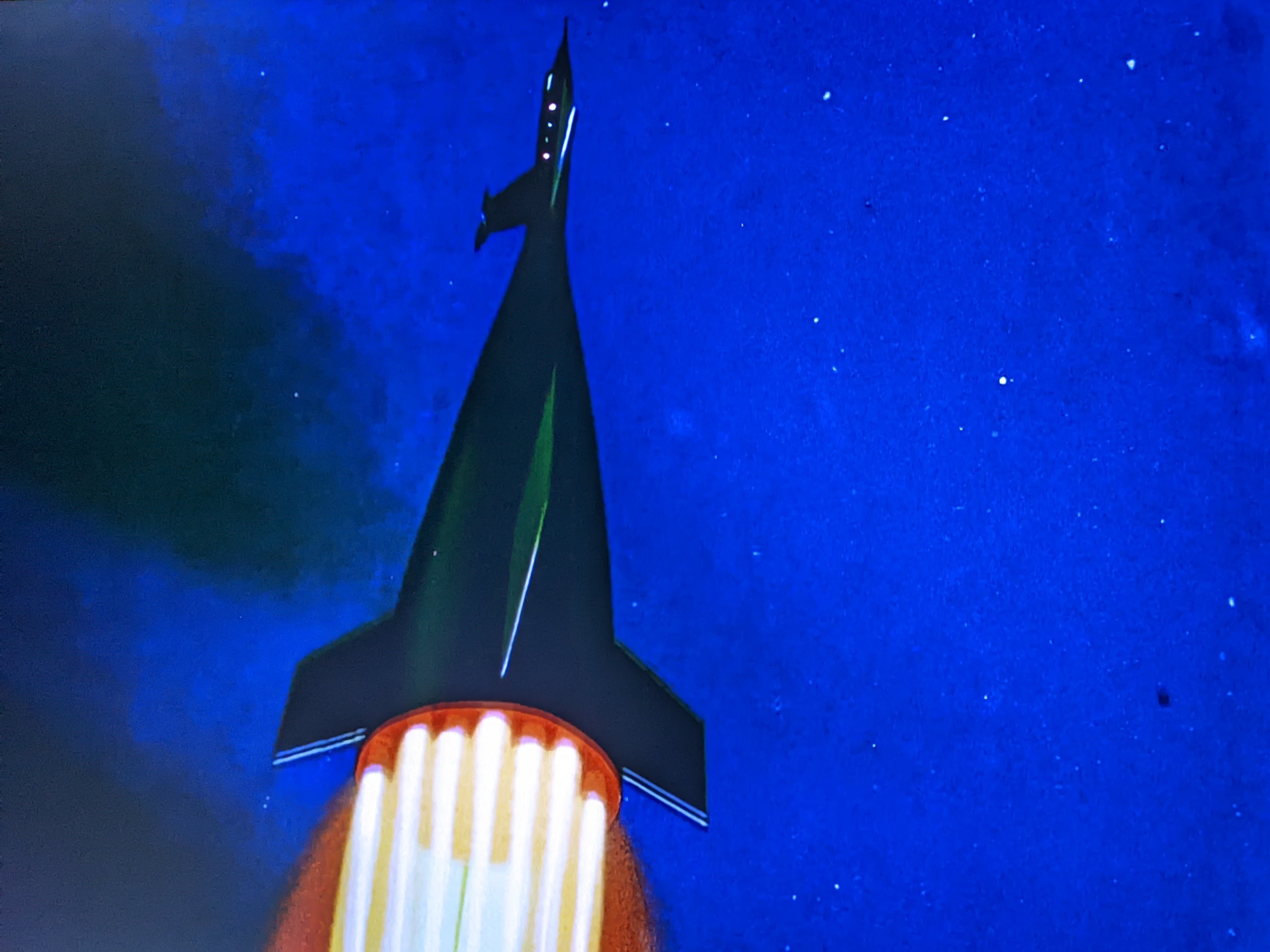
Spaceship rockets into orbit.
Short on animation, beautiful art, though.

Spacecraft in orbit.
Pictured: Not the space shuttle.

So, I'm torn on this one: On the one hand, this is a well-constructed, very informative, and absolutely prophetic vision of what mankind's first steps into space might (and in fact, did) look like. On the other hand, the cost of achieving this knowledge meant our government had to placate and cater to men associated with one of the most unapologetically evil regimes in recorded history (I suppose that's nothing new -- or past -- either). Of course, this is not at all brought up in the program, nor is there an explanatory placard at the start of the program explaining the "it was a different time" B.S. Was it the right call? I don't know, but it's enough to make me question whether or not I can recommend what should have been a slam-dunk "must-see."


"Man in Space" is currently streaming on Disney+, if you want to wrestle with morality.


Monday, September 11, 2017

The Rum Diaries (or rather, "why is the rum always gone?)

An anticipated follow-up to one of the all-time classics


Creators are funny things: Give them a vision, inspire them, and they can produce phenomenal works of incredible insight and entertainment. But collaborative efforts are a different thing altogether -- put two visionaries together, and you MIGHT get a classic work out of them, but more often than not you get clashing egos that tear a project apart. Get three artists in the top of their field involved and those numbers go down exponentially.

Why do I tell you this? Because I want to convey to you the rarity and outright insanity of the film, Fear & Loathing in Las Vegas. The film is a collaborative effort between well-known auteur filmmaker Terry Gilliam, the father of “Gonzo Journalism” Hunter S. Thompson, and the (at the time) delightfully weird Johnny Depp. It was a triumph: A film so grotesque, and yet so moving, that you couldn’t look away. With characters so dysfunctionally disgusting and themes so outside the norm of mainstream film that it should have imploded upon itself and remained forgotten in the annals of Hollywood history… But it’s not; it is now a time-tested classic cinematic masterpiece that introduced a whole new generation to the misadventures of Thompson’s alter egos, Raoul Duke and Dr. Gonzo.

While Thompson took his own life to escape the authoritarian, dystopian world wrought by Bush-era politics, Gillam and Depp went on. It’s arguable to say that Gilliam hasn’t quite made a name for himself since, while people are beginning to tire of Johnny Depp (much in thanks to a certain pirate movie franchise and his stale collaborations with walking goth pastiche Tim Burton).

So, when Depp chose to star in and produce a “follow-up” film based on Hunter S. Thompson’s novel, The Rum Diary, it could be said that the excitement was high. Thompson, after all, was known for underground articles and flourished journalism where he was a central character, not just reporting the news but providing his views on it. And while The Rum Diary is on the whole or at least semi-fictional, it is quite obviously inspired by Thompson and his central character, Paul Kemp is another self-insertion into the world of the novel (which is based on his own time in Puerto Rico).

But then, Terry Gilliam (who to my knowledge has never made a sequel to any film) wasn’t directing, and Hunter S. Thompson took an early retirement aboard the bullet express. And this is why the film simply cannot compare to the “original.”

The plot, unthickened


The story is about as disjointed as the original film. Paul Kemp is a journalist and failed novelist who takes a job in Puerto Rico with a paper called the San Juan Star. Among his failures are his inability to speak Spanish and his alcoholism, which is raging at the beginning of the film. As the story goes on he meets the usual cadre of Thompson-esque freaks in the form of drunks, users, and degenerates – in this case his co-workers. Along the way he gets involved with a white-collar criminal named Hal Sanderson, who is seeking to exploit the island, rob the people, and exploit its resources the first chance he gets. Kemp seems to roll with Hal’s ambitions, both too meek to question his motivations and too poor to refuse. Along the way Kemp and his friend, photographer Bob Sala (a much more sanguine Dr. Gonzo stand-in), have a run-in with the law, break confidentiality reports, and generally spend the movie in a drunken stupor. Kemp falls in love with Sanderson’s girlfriend Chenault, as he misses deadlines and watches the paper he works for eventually spiral and collapse. There is plenty of cockfighting (literal in this sense) in-between.

That’s basically all that happens in the film, albeit for 120 minutes and told with (slightly more) flourish.

So why doesn’t it work?


The movie should work: The characters are weird, the sets are period-appropriate, the actors are fantastic, and the world they inhabit is both shiny and chrome in that early 60s kind of way, but also becomes disgusting and decrepit in the cesspool of the Puerto Rican slums.

No, there’s one simple failing the movie has, and that’s direction. Don’t get me wrong, screenwriter Bruce Robinson tried his best, and I’m sure he had a lot of input from depth, but while his direction is competent, it’s not really good. I know that sounds harsh, and well… it sort of is. This is his first directorial film since 1992’s Jennifer 8, and it shows. He obviously has a love for Thompson’s work, but let’s face it: He’s not Terry Gilliam.

It all boils down to energy, and it’s something that the film sorely lacks as it wistfully plods from one set piece to the next, with Depp’s Kemp more of an observer than a participant in most of the scenes. This was done semi-intentionally, of course: It is supposed to be a younger and less “Gonzo” Raoul Duke in his formative years, but regrettably with one exceptional scene near the end (a visit to a voodoo witch doctor) there is none of the fast-paced insanity of Fear & Loathing in Las Vegas. What we get instead is a lot of medium frame static shots of people talking, and while the dialog is painstakingly adapted from Thompson’s own words (and delivered in a weird, Wes Anderson sort of play-acting), there’s just not enough happening artistically or thematically to drive the story.

The bottom line


If you’re a fan of Fear & Loathing in Las Vegas, re-watch it. There’s nothing really inspired or invested in this film to consider it worth viewing. I applaud that Depp wanted to reprise the role, but this is not the same weirdo that we fell in love with back in 1998.

The sad thing is, after the critical panning this film received, we may never get any other adaptations of Thompson’s other works, but if they’d be anything like The Rum Diary, we’re not missing much.


Friday, August 18, 2017

A Salesman's Odyssey

A fictional story, inspired by true events!


“Do you know Adobe?” she asked.

“Yes! I’ve been using Adobe Creative Cloud for years now,” was my reply.

“What about InDesign?”

“I’ve used it for years. I used it at my previous job to create manuals, pack-in sheets and pamphlets. As a matter of fact, that portfolio you’re looking at was made in InDesign.”

“Have you ever done sales?”

“Well… No, but I used to answer the phone at work in an effort to try to help the salespeople out. I didn’t have access to QuickBooks or anything to enter orders with or to take money, but I endeavored to be courteous and to help the customer out as much as I could before sending them to the sales department.”
“Well, this is directly interacting with customers. You’ve never done that have you? I mean, would you be willing to do that?”

“Yes, I’d be willing to learn.”

This exchange happened eight weeks before my first (and last) job in the sales department of a small local newspaper came to a sudden end.

I should point out that nothing I told my future (and now former) boss (who I will refer to as “Mary Beth” from this point forward) was a lie: I have indeed used Adobe Creative Cloud (and specifically InDesign) for years, and I have never done any sort of sales, and believe it or not, I was genuinely willing to learn how to sell. But that was my problem, you see: I had expected to have training, and that was a mistake.

I had been hired to take the place of another employee (let’s call her “Sally”) who had been with the company for five years. That number was important, because I was attempting to fill those shoes quickly, and during the full two-and-a-half days of training (yes, I’m not making that number up) that I had with that employee, I learned that no one there seemed to know who their various clients actually were (often referred to in vague references of business names), that all of their graphic design was done in InDesign, that any “art” used in the paper was downloaded clip art, and that in 2017, with clear access to simple and numerous database programs, people still used a pile of index cards to write sales leads on.

But things really got tough after “Sally” left. I made an honest effort to track down who the various clients were, only to find out that much of the contact information I was given was grievously out-of-date, but I persevered. It was rough trying to go from a constantly up-to-date Adobe Creative Cloud InDesign on the PC to a horribly redacted version of Adobe Creative Suite on a Mac, which itself had not had an OS update in years, resulting in web browsers that no longer worked and weird program glitches that seemed to happen from time-to-time. It was made all the worse by the fact that “Sally” never had any formal training with InDesign and had never actually bothered to learn any best procedures while using it, resulting in files that were far more difficult to edit than they needed to be. Still, the few ads that I made from scratch were lauded by my clients, and that felt good.

The great unraveling


I think that I knew the end was coming when one of our biggest healthcare clients told me that they wanted to, “see what I could do.” I spent (probably too much time) crafting an ad that used their web page’s colors to great effect, coordinated fonts to look smooth, and colored text boxes with indent spacing so that they could be resized on the fly with the text, making future manipulation better. It looked professional, and I was proud of the job that I had done. The client wasn’t, and kept asking for revision after revision, until finally they gave up and said, “we’ll have our people do it next week,” indicating that I lost the sale for that week. I was crushed by this. “Mary Beth,” rather than being a supportive boss who could have listened and been supportive, decided at that moment to basically yell at me that I should have just done what “Sally” did, and had me look at their previous ad, which was a mess of colors, mismatched clip art, and about six different fonts willy-nilly throughout the page. That was when “Mary Beth” decided that the large clients were too important to entrust to me, and began taking them for herself.

This, of course, made my job even harder, because now I didn’t have the large client base that “Sally” previously had. What’s more, “Mary Beth” hired another salesperson (we’ll call her “Anna”) who was experienced, full of enthusiasm, and ready to make some sales… Until over the course of three weeks I watched “Mary Beth” whittle down “Anna’s” enthusiasm to the point the poor girl was just sick at the thought of coming to work.

Now before we go any further, I want to say that I don’t entirely blame “Mary Beth.” She is a capable woman, that much is true, having started several businesses from scratch. That is admirable for a mother of three with no formal training. The staff at the paper I worked for were great people, and the loss of “Sally” coupled with next-to-no-training and a steep learning curve for new employees really affected the cash flow. Because she suddenly had to take on so many of the responsibilities of her former protégé, she was understandably under a lot of stress.

That didn’t make her any easier to work with.

From this point on, “Mary Beth” would loudly affirm that everyone should have been making sales calls, that there should be no typing, just calls calls calls. But here was the reason that it took me so long to make those calls: I had started my own personal database of contacts, so that I could record short notes of who I called, what I said to them, and how they responded. This was important, because even though I was writing it down, “Mary Beth” would ask me if I had called a client out of the blue, thinking that I was not, but here’s the other thing: Almost none of the people I called ever answered their phone, and a fair few even told me to communicate via email only. Once I started taking these notes, I could look up a conversation in a matter of moments, rather than having to dig through the archaic paper lists that she had us using.

What’s more, “Mary Beth” began assigning us clients to call on, but she herself couldn’t keep a damn thing straight about whose client was whose, giving sales that I had made previously to the other salespeople. This culminated in a moment where “Mary Beth” began grilling me on who I was calling, accusing me of ignoring a client – that she had assigned to the other salesperson. At this point I almost blew up at her, telling her that her system wasn’t working, whereupon I was given an angry speech that “it’s worked for seven years now, there’s nothing wrong with it!” before she dimwittedly gave a client that I was actively working with to another salesperson not five minutes later (true story). After about three weeks of “Mary Beth’s” needling abuse, “Anna” quit, and quite honestly, I envied her… But I’m no quitter!

“It’s worked for seven years now, there’s nothing wrong with it!”
-Mary Beth, right before it didn't work

Selling ads for a weekly free newspaper isn’t easy, despite what “Mary Beth” would have one believe, but learning it under the gun is even worse. People (usually small businesses) pay good money to have a small ad put in the paper for weeks at a time, and very few get any traction from it at all (believe me, I’ve asked some of the people I’ve sold ads to in the past). When I worked for the paper, I was put in charge of employment ads, but if the position is filled they’re not going to advertise again. If they get no responses from your publication, they’re not likely to advertise again – ever. Even if a daily paper is expensive to advertise in, they’re more likely to use it because daily papers are typically delivered to the reader’s door, and not picked up at random gas stations. Moreover, employers will pay the extra money for an online option so that they not only get tech-savvy people, but because getting data from an online form is much easier for a large business to deal with.

The graphic design wasn’t easy, either. Don’t misconstrue that: There’s nothing magical or special about creating graphics for a newspaper, but there’s something difficult about making graphics for a paper that is run by “Mary Beth,” who would constantly state that “Sally used to make graphics while she was still on the phone with a client and have it sent over to them while she was still on the line!” Personally, in the nearly three days that I spent training under “Sally,” I had never seen her do this, nor noticed any indication that she ever had. I did once watch her painfully and ploddingly manually resize the text in the columns of a feature for almost an hour, a feat that took me about two minutes to do BECAUSE I KNOW HOW TO USE INDESIGN DAMMIT – sorry, that was uncalled for. I can believe that “Sally” never spent more than a few minutes with her graphics, however, because trying to make edits to them was a nightmare of shape layers acting as the backgrounds of text boxes, weird combinations of fonts, not a single paragraph style anywhere to be found, and a drunk freshman’s understanding of color theory. To be fair, most of her ads looked fine, though a few left a lot to be desired (she had obviously honed it with time).

So early in what would become my last week I began calling in volume. I stayed focused, which wasn’t easy with “Mary Beth” constantly coming over to tell me that everything I was doing was wrong and that “Sally” could have done it so much better and faster. “Mary Beth” sold an ad that her client sent to her in a Microsoft Publisher file, and she couldn’t figure out how to open it, but I had Publisher on my machine and told her to send it over. It took me about 10 minutes to create an InDesign file equivalent of the publisher one in our paper’s format from nearly scratch (it was seriously easy), but instead I was told that I had taken too long with it. Other little interruptions like this broke out throughout the week, and I got them all taken care of quickly, so that I could concentrate on my calls.

Simply using the list of contacts that I had built-up. Between Tuesday and Thursday, I had made around 70 calls, and sold three small ads, which wasn’t enough to meet my sales goals for the week. When I came in on Friday “Mary Beth” was already there, along with the editor-in-chief (I’m guessing that he was there as backup in case anything happened). She informed me that “It’s not working out, and I think you know that.”

I packed up my things and left, but before leaving, I told her, “You want my advice? Get “Sally” back. Double her pay if you have to, because you are LOST without her.”

My advice to anyone out there, learn to spot a “Mary Beth” before you work for him or her. These people are usually religious (in the sense of status and ease-of-offense, not necessarily the ‘love your fellow man’ bits) and very embedded in the community. They get where they are by smiling and sucking up to power, are very passive-aggressive, and in private are the most miserable people you’ll ever come across. I can’t explain it, really. Let’s just say that I once saw “Mary Beth” at an event which was fun and exciting, where she was a participant. If one was to take a photograph of her during this event with a telephoto lens, she would be glowering and look like the most bitter and hateful person you’ve ever seen trying to have fun. That is not a fun person to be around, and that is not a good person to work for.


And so my odyssey in sales ends. I’m not unhappy to be rid of it.